
Tag Archives: tranquility

Kids – a useful mindfulness tool!

2015-01-16 14.08.01

It’s often when we need it least that illness can strike. Although saying that is there ever a good time to be ill? All week I have been catching up with my work – both from my day job and from my mindfulness teaching work that I do. Blog posts, emails, advertising, lesson planning, proof reading my new mindfulness booklet, burning CDs and labelling them – it all takes up time.

And last week I was unable to do any of these day to day tasks as I was on retreat in Lockerbie, although at times I blinked and found myself remembering Tibet and my travels there. It was a wonderful, nourishing retreat and also very hard work. And of course this week has been all about playing catch up.

My oldest has had a hacking cough all week and I have insisted she trudge in to school every chilly day so that I can get my work done. She was fine and she didn’t need a whole week off but today she looked at me and just said ‘mummy, I think I need to rest my voice’.

As a teacher I know that feeling only too well so I relented and said OK you can have today off. This caused a meltdown in my youngest who on twigging that the oldest was having a day off decided he too was so ill school was not option.

As I almost dragged him bodily into school, a forced smile on my face, and the oldest ‘ill’ one kept skipping with delight (in between hacking coughs) at the idea of having a whole mummy day at home, I recalled, or perhaps it was somewhat later, what Jon Kabat-Zinn says about kids.

Let your children be your own zen master, he advises. That way whatever they throw at you, you can take a deep breath and tell yourself this is all part of the practice!

Total Practice Time: So far today ZERO, but the intention is there!
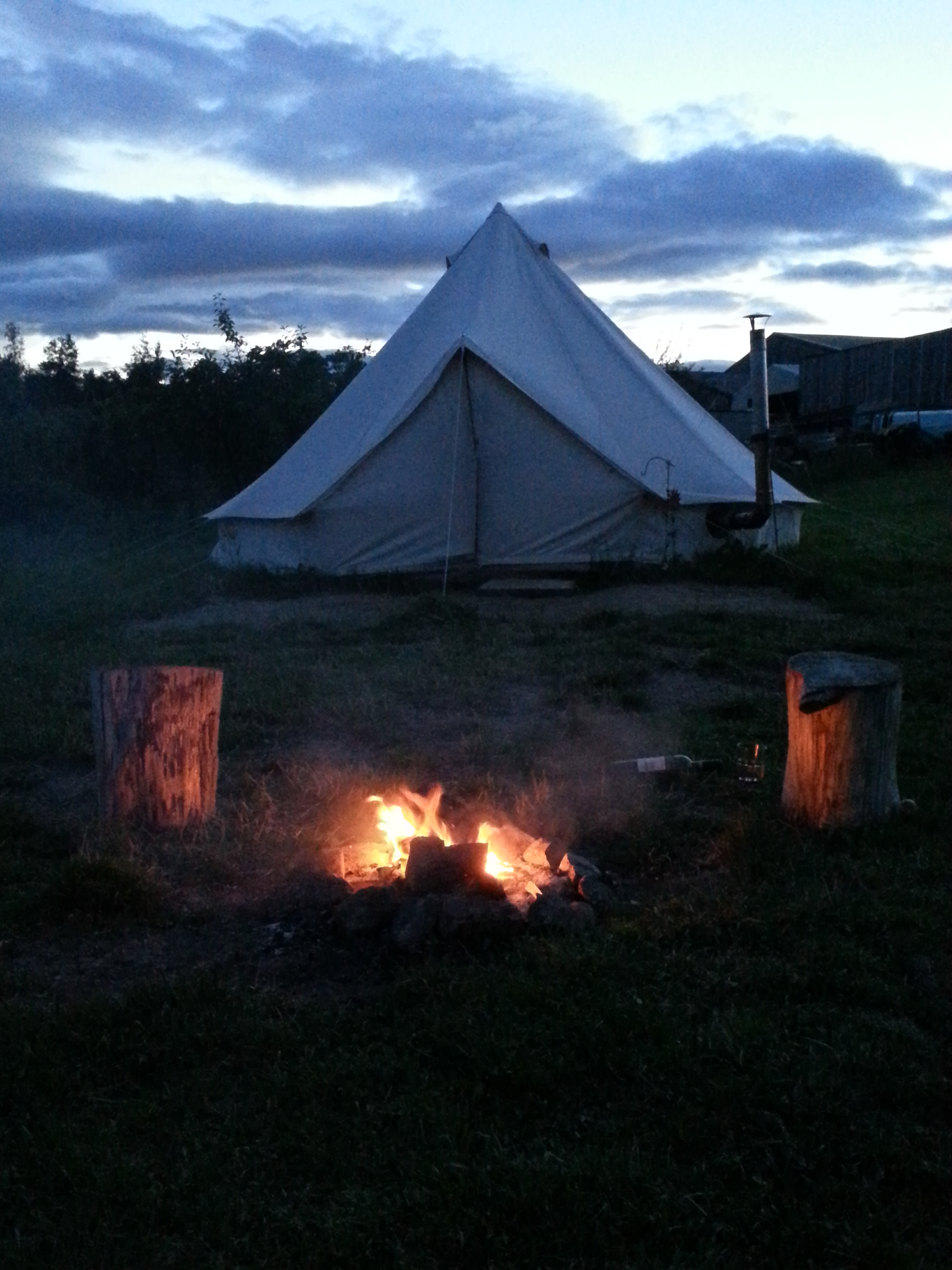
Camping: the ultimate habit buster

Glamping fire

Last year for my family holiday I went glamping, in a beautiful bell tent with the hubby and kids (then 3&5 so you can imagine there was nothing remotely glamorous about it). It was lovely and testing and different all at once.

Holidays are what get us away from our routine, from the nine to five grind of school runs, doing homework with reluctant jiggling young children and commuting into London. To stand back, take stock and have a rest is so welcome even though with young kids there is no rest, only a change of location in which you perform the never ending round of get up, entertain, cook , cajole to eat veggies, clean teeth and then usher bedwards.

It was hard work being in a tent, losing my space to practice any form of meditation or yoga and then when the children finally did go to sleep it was usually only half an hour later before it got dark.

Talking to someone recently about camping they said ‘It’s the ultimate habit buster, you have to change the way you think and change the way you do everything, from going to the loo in the night to washing the dishes, nothing is how you usually do things when you camp.’ That is so true.  The practice was just being there, watching the flames flicker each night by the fire as we had a medicinal glass of wine and talked briefly before crashing out to face another 5am wake up call from our youngest and most excitable child.

This year’s holiday was more civilised – a farm house with my extended family. I had space and time to do Qi Gong everyday and meditate as much as I wanted. It was bliss compared to glamping but I wouldn’t completely rule camping out in the future because there are very few experiences that get you right back to basics, it just might be more rewarding once my son has stopped waking up at 5am.

And for those of us who go away only once or twice a year there are so many ways to shake things up in our daily lives in between holidays, from changing where we sit to watching a random film we know nothing about, little and regular changes to our daily routine can help us recognise and even change our sometimes unhelpful habitual behaviour.

Today’s total practice time: 20 minutes

Learning to dance again

In week seven of an eight week mindfulness meditation course we explore the exhaustion funnel. When teaching this class I quote from This Frantic World which says in some countries doctors don’t ask ‘when did you start to to feel depressed’. Instead they ask ‘when did you stop dancing?’. I have yet to find out which country it is that has such enlightened doctors but I am tickled by the idea that perhaps in some utopia there may be salsa on the NHS!

This is a preamble to say that dropping the things that nourish us can cause us more stress than hoped. A person may drop all sorts of ‘optional’ pastimes in the name of clearing the decks or making more time. But they then may wake up a few years later burned out and with little joy in their life. Hence the question is really when did you stop doing the things you loved and start only focusing on work/children/caring responsibilities/obsessive house renovations (delete where applicable).

The good news is that none of this is irreversible. As Jon Kabat-Zinn frequently says there is always more right with you than wrong with you. Reclaiming your life is a big part of week seven and a big part of living mindfully. Being able to ask yourself, ‘what is the best thing I can do for myself right now?’ and perhaps deciding it’s a cup of tea rather than whittling away at your seemingly endless to do list.

Today’s Total Practice Time: 30 minutes

The Body Scan

The body scan meditation has been much on my mind of late, I have been doing it everyday for a month so I am feeling intimately acquainted with it. I haven’t done it with such gusto since I first came to mindfulness, it almost feels like revisiting an old friend.

The body scan provides the firm foundations for an eight week mindfulness course. It often makes up the bulk of home practice from week one or week two in an eight week course. Often described as the marmite meditation because people sometimes love it or hate it. Very few feel ambivalent towards it.

Why does it trigger such a response? Because it shows the doing mind participating in some of it’s most doing mind antics – it judges, analyses, compares. Perhaps all good things when you are working. But when you are lying on a yoga mat trying your best to feel your big toe perhaps the body scan shows the doing mode as a tad impatient and reticent to just let go and be in the moment.

So why bother, as early as week two especially, with a challenging meditation?

It’s precisely this challenge that gives participants an opportunity to really try to be mindful. The body scan allows participants to better connect with their body. It also allows them to see the doing mind in all it’s chattering glory. It provides ‘resistance’ training. If you can do the body scan twice a day for the next week having never meditated (at least daily) before, then the rest of a mindfulness course will be peachy!

Today’s practice time: 30 minutes (the body scan of course!)

Thursday 30th January 2014

I can vouch that this mindfulness stuff really works! I know I would say this – I am a passionate practitioner and teacher but today I had a moment or several, when I could feel such a fundamental change in my perspective. Today my perspective on several events were so different to how they would’ve been a year or so ago. First walking the kids home from school with two of their friends we see a fire engine outside our house. A while ago I would have assumed the worst and thought my house was on fire but today I felt only curiosity. The kids got to sit in a fire engine as well which was a nice start to any play date! Then the play date itself: two five year olds and two four year olds under one roof, this was the type of situation that would see me feeling stressed but today I surprised myself by enjoying it. Today’s total practice time: 20 minutes