Category Archives: Mindfulness Practice Blog

when did you stop dancing?

Dancing used to be a huge a part of my life, at one point dancing was a weekly event, sometimes several evenings each week when I was young would be spent dancing. Slowly over time of course no one can sustain a three times a week clubbing habit and so with the onset of kids, middle age and moving out to the burbs I have watched my dancing life dwindle to such a point that if I can count three times I have danced in a year I feel I am doing quite well.

Mark Williams et al in their ever insightful Frantic World book report that in some countries doctors don’t ask when did you start feeling depressed but instead ask when did you stop dancing. For me it’s a pertinent question and one of course that we can all adapt to mean when did you stop doing the things you loved doing and become a mass of duties and responsibilities, a fun-free zone?

For most of us it’s a similar response. First there was the mortgage, then the kids, then the extra hours and responsibilities at work and suddenly I was whittling down all the things I enjoyed to make time and space for the serious business of paying a mortgage, renovating a house and raising a family.

And then of course there’s the big part alcohol plays in all of this socialising. I am not at the stage of total abstinence and still have the occasional tipple but again these days it is very occasional. For a reserved Brit drinking and dancing often go hand in hand so how can you sustain a dance habit when your whole life is now cleaner and more sober in general?

Can I even dance when I am sober?

This is a question I answered in a cold school hall at 10.30am yesterday morning when me and my daughter became initiated in a family friendly five rhythm’s dance. I have always shied away from five rhythms, using the nickname rainbow rhythms in a disparaging way when others have talked about it, thinking the whole thing is a bit too Chakrha laden and new age-y for someone scientifically minded like myself.

The answer though was happily a resounding yes! Five rhythms is quite leftfield and not everyone’s cup of tea but if five rhythms (and a chilly school hall at 10.30am)  is the only way I get to have some communal dance in my life, beyond my kitchen, then so be it. I’m ready to have more fun and I’m up for journeying outside my comfort zone to facilitate this so that I never have to say I have stopped dancing for good.

Today’s total practice time: 1 hour silent practice at Mindful Sunday  thismindfullife.net/mindful-sundays + 30 minutes personal practice
sites.google.com/site/cambsdance

Resurfacing

I came out of retreat more than two weeks ago, blinking like a mole in daylight for the first time. Travelling through London on the tube at rush is almost too surreal an experience after five days of silence and stillness. Suffice to say it felt slightly psychedelic, like the colours and noise were cranked up just a little too much.

The retreat itself was a delight. It was very different to any retreat I had done before. I found myself comparing it to previous experiences and finding it didn’t quite measure up. It was too short, too easy and too still and yet I knew it was exactly the right retreat for me at that moment. I found myself judging the Qigong (often with the words ‘this is so lame’ ringing in my mind), unspoken they felt all the louder.

I arrived late and was put on lunchtime pot washing detail for my work hour which meant I was out of sinc with most other retreatants and I lamented not getting that lazy lunch hour that was such a celebrated part of my previous retreat.

For some of the time I was holding on to that previous retreat, remembering one sunny afternoon when after a lovely veggie lunch a load of us lazed around on the grass in the sunshine. People I would never see again, many of whom’s names I didn’t know, and yet in that moment I felt so utterly and wordlessly connected to them. It was pure joy.

By day 3 I shed the old retreat and made friends with this present one. It was a much easier retreat in many ways, for a start I had only one room mate (not three) and she didn’t snore or use the toilet twice each night. I was sleeping well, I came out of the retreat feeling more revived not less.

And the Qigong was pretty still and I struggled with that – with boredom, with stiffness and restlessness. But it gave me so much to work with. I had to be with the body and all its aches and pains, whether I wanted to be or not. I had to do the dull movements for eight hours each day because I was there and I might as well take part. And I grew to love them and the breath works we were taught.

Two weeks later, even though life has been one busy blur since coming home, I still do those movements and the breath work everyday and my practice has never felt more stable.

Today’s Total Practice Time: 1 hour (Qigong, movement and breath work)

Lightening the load

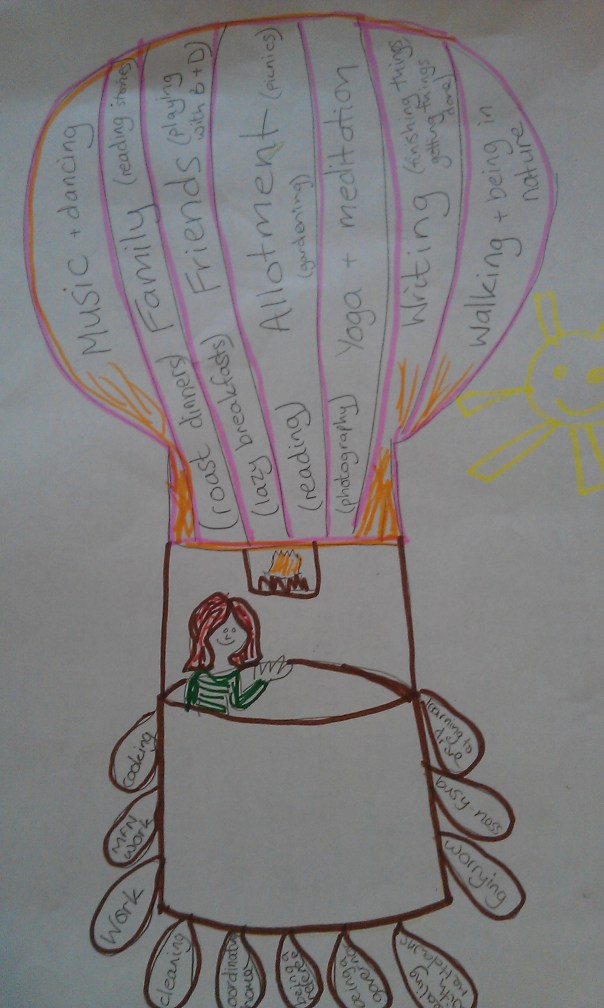
In the eight week Mindfulness-Based Parenting Programme I teach we encourage parents to draw a picture of a balloon with sandbags. Now we all need a bit of ballast to keep us from floating away into the stratosphere but too much weight will see us permanently grounded. So like many things in life, it’s all about balance. When I did this exercise a few months ago I realised I had too much weight dragging me down.

The last year has been a busy exciting haze of taking voluntary redundancy and heading off into new career territory. It’s been a bumpy ride, the kids don’t like me working more days and longer hours, we’ve had to negotiate a lot of childcare arrangements so that everyone’s needs are met but a year since applying for (and getting) voluntary redundancy I can honestly say it was a smart move and one that I have not regretted.

But my balloon was still too heavily weighed down and something had to give. Part of the point of these exercises is that it gives you the chance to stand back, reflect and take stock. There are some sand bags (being a parent full stop is a massive sandbag for example) that are not likely to go away. Cooking, cleaning and work are all sandbags on my picture but these need to be done. However two of the biggest sandbags over this last year have been being a governor (I urge anyone to give this a go, it gives you a taste of local democracy in action but only if you have the time – I realised I really didn’t )  and learning to drive. Both activities really drained my resources and time and yet gave me very little pleasure.

imag0412

So I handed my resignation in after three years of being a governor, I had procrastinated the whole summer and then with one simple email it was done. A very heavy sandbag had been severed from my balloon making me feel instantly lighter.

The second sandbag I have been trying to sever was not quite so simple. It isn’t particularly easy or pleasant learning to drive at any time in your life but when you are 45, dyslexic, extremely busy with few slots in which to book either lessons or tests, have zero interest in cars and have never even wanted to drive in the first place – then you can imagine it was a very challenging learning curve. I started out consistently having weekly lessons but around spring the lessons got patchy especially for every school holiday. I had several months when I didn’t have any lessons. I found both driving instructors I had hard work and quite unprofessional. And the knowledge that if I still lived in North London I would have happily yielded nothing more than my Oyster card well into my dotage didn’t help. And don’t get me started on how uneasily it sits with my green credentials.

But I got to the point where I had ploughed too much time, money and energy into this venture that I had to plod on with the whole joyless exercise. So plod on I did and 14 months after first stepping into a car and with numerous gaps in lessons I passed my driving test on Thursday. Delight wasn’t even close to what I felt, instead I was flooded with utter relief that it was over and I could now do things that interest and nurture me on my precious one day a week without the kids rather than sitting in a car being shrieked at about the give way rules of a roundabout by a highly strung instructor.

So I am feeling light and buoyant right now. Severing these things that drained my resources has left me with the space and energy to do other more pleasant things. I am meeting a friend for lunch today, plan to go out in London after work next Wednesday (which I haven’t done for ages because Thursdays were frequently driving lesson days) and I am getting excited about my retreat later this month.

Be aware if you do clear away some of your own sandbags there will be an overwhelming urge to instantly fill the gap with more crap. Two days after freeing myself from my governor role I started talking to my husband about my desire to become a union rep at work, he didn’t even need to say anything, he just kinda looked at me with a bemused face that seemed to say there she goes again, the queen of busy-ness! ‘Maybe I’ll give it 6 months before doing that,’ I found myself saying.

From next week I’ll be working four days a week in London. That’s the most I will have ever had to do the commute and instead of feeling worried and overwhelmed by this prospect I feel that clearing the sandbags has allowed me to have the energy to accommodate this change in working patterns. It’s only for eight weeks and then I go back to 3 day weeks. My house may get dusty in that time, I’m cool with that, but at least I won’t be squeezing committee meetings and driving lessons into the few spare moments I do have to relax.

Today’s practice time: 10 minutes movement, 15 minutes seated practice


ground hog day

Monday mornings seem to often have the same familiar pattern. We all sleep in and struggle to get out of bed even though the night before was not any later than usual. The kids grumble about not wanting to go back to school, I say something bright and cheery like hey ho, only 3 weeks to go before summer and one of them bursts into tears because they thought it was only two more weeks before summer. My husband makes a hasty exit and the kids won’t see him again until Tuesday morning.

Everyone moves very slowly, I try my best to encourage, bribe and sometimes coerce a more speedy start. It all grinds to a halt at breakfast while my daughter goes from slow mo to freeze frame. With only ten minutes to go I find her whimisically staring out the window as she is meant to be brushing her teeth. I go to brush my teeth leaving them for all of 2 minutes and then when I get back of course one of them is crying claiming the other one punched them. I am losing the will to live and it is only 8.30. I file the incident under ‘sort out later’.

We walk to school and today that part went well except when we reached the school gates I realise the kitchen clock is 10 minutes slow again (it keeps doing this and then fixing itself, which lulls you into a false sense of security) and so we have actually arrived ten minutes later than hoped.

My daughter is given a damning red slip by the school office and looks even more anxious that she is arriving late. I stroll off to my allotment wondering how I can avoid this inelegant start to our week. Being a woman I naturally assume it is my job to fix this mess.

I lose myself for several hours while weeding and strimming and afterwards I take the blanket out of the shed and lie in the shade watching the clouds go by. Part of me wonders what the old boys might make of this left-field behaviour but a bigger part doesn’t care. I am completely in the moment, and in that moment it feels like everything will be OK.

Today’s total practice time: 10 minutes formal siting practice, 10 minutes informal practice – watching the clouds (I recommend it!)

external events

On the 8 week MBSR course I teach in week 7 we look at how we often drop our most nourishing activities at the very times when they are so needed. Feeling stressed and overwhelmed? Out go the yoga classes. Short on time? Cancel on your friends. Working late? Order in a take away. It seems this is part of the human condition, something we all share – it’s a struggle to look after yourself when things are going well, forget it when things are going badly.

There is no magic cure for this very human predicament and I know people with decades of meditation practice who still succumb to this phenomenon. However the best thing we can do to at least stay on top of this is to pay attention to it, perhaps offer it a friendly if rather wry smile, accompanied by the thought ‘hello old friend!’ If we are aware this is how we behave when we are stressed research has shown we are much more likely to emerge quickly from the other side of the dip.

I can imagine many people dropping healthy ways of being in the last week, as they have become sucked into the cycle of 24 hour news and worries about the future. That has certainly been my own experience since events have unfolded in the UK. Earlier this week I halfheartedly pulled my practice back together, reclaiming the very act of self care I need most at this time, not because I felt like meditating but because I had to. Procrastination and worry have never helped me feel settled, meditation does.

It is that simple. But of course as many have observed, it isn’t easy.

Today’s total practice time: 20 minutes movement and compassion practice

a paradigm shift

When I was in Brighton this weekend to support my sister as she ran her first and (she professes) only marathon I was struck by the huge amounts of people who had given up time and energy to train to run this 26 mile challenge.

Men, women, old, young and people of diverse nationalities, it seemed, had decided to give the Brighton marathon a run for it’s money. As we stood around waiting for glimpses of my sister on the epic route we mused about what gives people the running bug.

There were drums, clackers and lots of banner waving and a huge amount of support as people wrestled with their body as it screamed stop and their mind which was set on finishing the marathon and gaining a medal.

In his book Mindfulness in eight weeks Michael Chaskalson makes the observation that in 1970, the first New York marathon had only 127 entrants and fewer than half of those made it to the finish line. By 2010 44,829 people finished the New York marathon which at that time was a world record for marathon races. And each year all the big marathons around the world are hugely oversubscribed.

Chaskalson makes the case that somewhere along the line in those 40 years a paradigm shift had taken place. In that time running, jogging, gym membership and yoga became common place. He proposes that we are set for another paradigm shift – that possibly in 40 years time mindfulness will be as common place as jogging. Mental fitness will take it’s natural place as an equal alongside physical fitness.

It’s a great and optimistic vision and one of course I hope comes true but with out the support of friends and family it can be challenging to run a marathon. And for the person who tries to make time to meditate it can also be a challenge if those around are not supportive and understanding that to cultivate any practice routine, be it mental or physical, takes time, energy and patience. The rewards are not so instantly apparent with mindfulness and no one will hand you a medal on completion but in the long run it might be even more beneficial for all of us if that paradigm shift happens soon.

Today’s Total Practice Time: 50 minutes (15 minutes yoga followed by a bodyscan)

OLYMPUS DIGITAL CAMERA

Every marathon runner needs supporters!

new year, new me

It’s very tempting at the beginning of a new year to consider all the changes we should make, all the vices we should curb, all the virtuous activities we should take up.

There’s a certain level of striving in all of this, as though somehow old me from the previous year wasn’t good enough. The reality is that the person who was making all those unhelpful life style choices last year is still very much alive and kicking after Big Ben has struck midnight on New Year’s Eve.

We’re now almost at the end of January and if you find yourself filling with remorse about your broken resolutions as you read this, worry not. Two thoughts come to mind – one is the truth about new year’s resolutions – that they are hard to achieve at any time of year and harder still in the midst of gloomy old January when the only flicker of joy amidst the long winter nights might be a large glass of Rioja or a chocolate eclair with a pot of caffeine fueled tea.

An article in The Guardian recently claimed the best time to start on a new you would actually be springtime, a much better time for new beginnings and fitness regimes. Especially as the article pointed out, if your new year’s resolution was to go running: it’s pretty much dark when you leave for work and dark long before you get home at this time of the year, so when exactly were you planning to squeeze in that run every day?

Year’s ago when living in Japan and asked by a friend about my new year’s plans I shared my humongous list of new year’s resolutions which remained unchanged for more than a decade. I can still say it like a mantra. (Give up smoking, drink less, do more yoga, meditate everyday and write that damn novel). ‘Blimey,’ he said, ‘That sounds more like you need a new personality to achieve all that.’ While I did manage to kick the smoking and did pen a very mediocre bit of fiction while living in Madrid that I now cringe at the sight of, the new me list remained largely underachieved.

My friend was right – I needed something to shift on a much deeper level to achieve all those goals. Fast forward a fair few years and once I finally cracked the meditate-everyday part of my own personal pledge (one random May please note, new year’s had nothing to do with it) I was finally able to achieve the other components, slowly but surely, and bring about lasting change.

I still haven’t written a novel I am proud of and my ukulele (a later edition on the list of well being) still sits dejected and dusty and very much un-played. But there is now less striving in my life so resolutions these days are far gentler – be happy for what you have, spend more time playing and being present with the kids.

If the resolutions ever get too ambitious I remind myself of the second thought that came to mind when belatedly writing about new year’s resolutions. It’s a joke of sorts. What’s the most Buddhist song of all times? Most people think it will be some monks chanting or a Beatles number about letting it be (or God forbid the Frozen ditty about letting go) but no, according to Robin Wright – professor of Buddhism and Modern Psychology at Princeton University (available for free on Coursera) it is in fact ‘I can’t get no satisfaction’ by the Rolling Stones.

Once we truly take on board that whatever we do, however big our house, however much food we have in that house, whatever salary we earn, there will always be a little part of us that is dissatisfied with what we have – then we will have made a significant break through. There will always be striving to change old me and actually when I had a multitude of vices, there was some merit in that. These days though I find myself shrugging and thinking you know what, you’re good enough.

Today’s total practice time: 30 minutes (yoga and a brief body scan)

https://www.coursera.org/learn/science-of-meditation

2015-01-16 14.08.01


Everyday Stressors

Coming into London the other day there was the unwanted and depressing announcement that due to a fatality on the line all trains would be delayed and possibly cancelled at short notice.

It seems most people’s first thought in a scenario such as this is towards the departed person that became a fatality on the line. Phones were fished out of pockets. People calmly and quietly explained to bosses and line managers dotted all over the capital that they would be late because ‘some poor beggar has bought it on the lines’, as one fellow commuter put it.

Then we proceeded to wait. It was cold. It was wet. It was the week before Christmas. It was the last thing any of us wanted to do but wait we did. For more information. For a train. For clarification.

I have yet to see a better example of collective acceptance as this. It was as though the whole platform sighed, with a nod of compassion towards the person who had died, and waited in a very stoical, polite and respectful kind of way.

Half an hour later, only after the train company, in their wisdom, cancelled and sent off (empty) a 12 carriage train only to announce a 4 carriage train would be next, did the annoyance start to be more palpable.

We were all late, for very sad reasons, but there was now a whole platform filled with disgruntled commuters trying to squeeze onto a very packed and tiny train. Some jostled and elbowed their way to the front. Others hung back. People started to moan about the logic, or lack of it, of sending off a lovely 12 carriage train at peak travelling time when the next train in line had so few carriages.

Anger was present, there was no getting away from it but still most people stayed calm. There were a few tuts, sighs and muttered swear words but as the 4 carriage train pulled away, leaving most people still waiting on the platform in the cold wet gloomy morning I felt strangely heartened. Most of us were able to face this disappointment with a sense of decorum.

Arriving at work after the forty minute wait on the platform, the forty minute slow train ride (standing up, feeling as though in cattle class rather than second class), followed by another 30 minute squeeze on the tube, I felt like I had already done a full day’s work.

But there were moments when the fog of disappointment cleared enough for me to meditate during the nightmare commute. Meditate on frustration, disappointment, acceptance and loss. The stressors don’t vanish but you see them for what they are: a string of annoying obstacles, coincidences rather than a conspiracy to ruin one’s day. And at the heart of the meditation lies compassion – for the person who died and their loved ones.

Total practice time: 20 minutes seated practice + 10 minutes walking meditation

Sticking with your practice come what may

Even someone with an established meditation practice has wobbles. At a training I went to earlier in the year a fellow participant brought a weeble along to her teaching slot and said mindfulness is like a weeble, we have wobbles but we’re less likely to fall down.

I had a few days last week when I did no practice. Or at least that’s how it seemed. I did no formal practice – stressed, busy, trying to tie up all the loose ends before another round of courses start my final push was hijacked somewhat by a fascinating election which lost me work time as I watched late night coverage and then recovered from sleeplessness the next day.

Two days with no practice affects me and so soon I was back in the quiet space – getting up early, peace and calm before the kids make their demands. But what impressed me most was that during those two days I felt very aware – aware of not practicing, aware it was quite nice, aware I felt it was a worthy reason (elections only come every 5 years after all) and just able to still inhabit the moment even though the formal practice had temporarily slipped.

Today as I got up at 6am and set about my silent practice before the day gets started, I felt a sense of relief. There will always be times when the practice slips – it’s wanting to return to it that counts.

Today’s practice time: 40 minutes (movement and self-compassion practice)

Grow Mindfulness Launch

A few months ago I was invited by the Grow Mindfulness group to their launch event at Westminster University that took place on Friday 13th March. I put it in my diary made a few inquiries about who could pick up the kids for me that day and with childcare secured, booked my free ticket,

Being in London on a Friday was a habit buster in itself and knowing the kids were being picked up by their favourite substitute to me – their dad – was lovely. Knowing everyone was happy I left early and chanced upon Dermot O’Leary’s dance-athon (it was red nose day and the BBC headquarters are two minutes from Westminster Uni) which further renewed the feeling that I was doing something a bit different and exciting on a school day (I’m a parent of 2 young kids with a very fixed schedule – so it doesn’t take much!)

The event itself was a good chance to network with other mindfulness teachers – much needed when so many of us work in our own little bubbles most of the time. There was an excellent talk on the neuroscience that backs up and supports everything we do when we teach these courses. On my courses I try to point out that it isn’t just Buddhists we need to doff our caps to, it’s the neuro-scientists who have proven with the help of MRIs that these practices can change our brains, helping us shift from the amygdala towards the insula.

But what was most heartening was that Grow Mindfulness is a grassroots organisation that literally wants to grow mindfulness and widen access to the eight week courses. Made up of committed passionate women from working class backgrounds, it was so heartening to hear them talk about broadening our scope and making sure everyone who needs mindfulness has some in their lives.

Quite how we will do this is still to be decided and without doubt the journey maybe a challenge but I left with a heart felt sense that this is an organisation that wants to shake things up a bit while connecting and supporting those at the very heart of mindfulness provision. That is an organisation worth supporting.

Today’s total practice time: 30 minutes seated meditation

http://www.growmindfulness.org/